The maths
The rule is short: every balance loses 1% on a fixed schedule, and the loss goes to the pot. Three levels follow, from a calculator to the proof.
Try a number
At the real setting, 1% every month. A month here means 30 days.
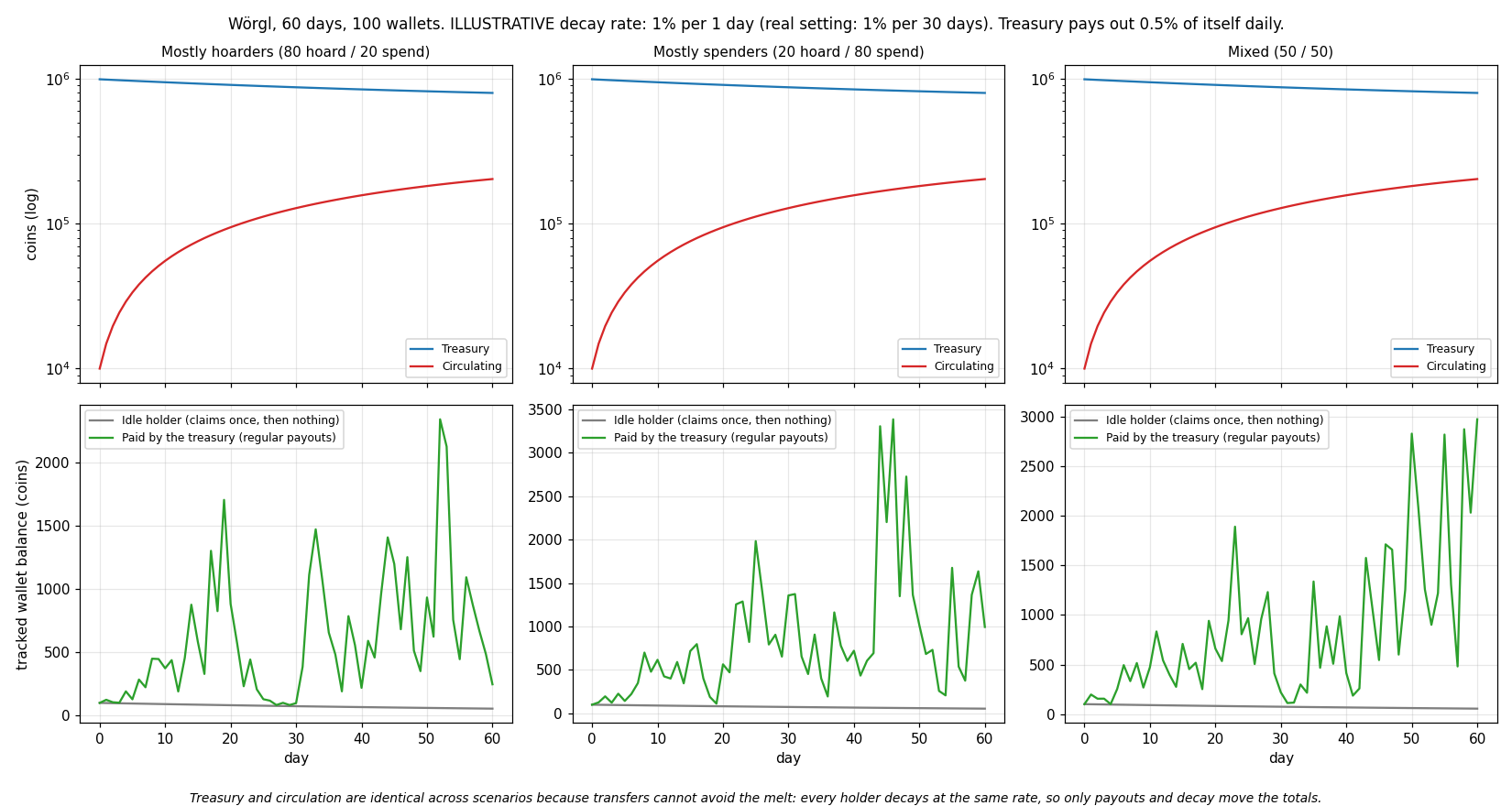
A 60-day simulation
The same rule runs at three speeds. The real setting loses 1% every 30 days, the live demo 1% every hour, and this simulation 1% every day. The chart uses 1% a day because 60 days of the real setting would barely move (about 2%), while 60 days at the demo speed would melt almost everything.
The proof
For people who check: shares and the index
Nothing on the chain changes every second. The contract stores your shares. One index falls with time, and your balance is worked out when somebody reads it.
balance = floor(shares × index ÷ 10^27)
Balances round down and the total in circulation rounds up, so rounding always favours the pot. Checks in the repository: the unit tests, the maths module, and two 100,000-step fuzz tests that check the supply is conserved. scripts/verify-testnet.sh re-derives these numbers from raw chain state.
Questions people ask? Next: questions and limits